
Click on a chapter cover below to read it in the sidebar on the right.

|

|
|
|
|
|

|

|

|

|

|

|

|

|

|
|

|
|
|

|
The Italian Poet Dante Alighieri wrote his famous allegory of hell, Inferno, in the early fourteenth century. It was the first part of his epic poem Divine Comedy. In his allegory, Dante takes a journey through nine concentric circles of hell descending at last to the center of the earth. As Dante passes through the gate of hell, he sees an inscription, which includes the famous phrase “Abandon all hope, ye who enter here.”
Dante packed the Inferno to excess with outrageously gruesome never-ending torments, basing them on medieval concepts of hell. In the superstition-saturated medieval mind, hell was much more than the judicial judgment of God. Dante pictures human beings writhing in urine, or frozen in ice and horribly contorted, or having their heads gnawed on by their enemies or enduring numerous other unspeakable horrors. In Dante’s superstition darkened mind, the earth would be polluted with unspeakable sin and suffering for all eternity, never to be cleansed and reinstated to its original Edenic state.
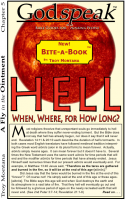
In this chapter we will investigate how the Bible uses the wordhell. Does the Bible ever use the word hell as a reference to a quiet resting place for the dead? Or does the word hell in English Bibles always refer to a place of torment? Is “hell” a place where “disembodied souls” think and feel, and communicate with other “disembodied souls” who reside beyond an impassable gulf at an otherworldly location called “Abraham’s bosom”? Can “disembodied souls” communicate with people on earth?
Is there an eternally burning hell located in the molten core of the earth? Or perhaps hell is nearer the surface, say, under the volcanic chain known as the ring of fire along the Pacific Rim. Maybe hell is just a figment of our imagination — just a metaphor Jesus and the Bible writers used to teach some moral lessons, as my maternal grandfather used to tell me. Of course, I don’t believe any of that. But what I believe really isn’t what’s important for you. It is very important for you to see for yourself what the Bible says about hell.
The Bible teaches that hell is a future event. There is a “wrath to come” (Luke 3:7b) “For, behold, the day cometh, that shall burn as an oven.”(Malachi 4:1) “As therefore the tares are gathered and burned in the fire; so shall it be in the end of this world.”(Matthew 13:40) “So shall it be at the end of the world: the angels shall come forth, and sever the wicked from among the just, And shall cast them into the furnace of fire: there shall be wailing and gnashing of teeth.”(Matthew 13:49-50)“Jesus, our Saviour from the wrath to come.”(1st Thessalonians 1:10 BBE) (For further study see Malachi 3:18; 4:1-3)
God’s version of hell, as described in Scripture, pictures a vast lake of fire on the surface of the earth, which will penetrate to its very core.
“And they went up on the breadth of the earth, and compassed the camp of the saints about, and the beloved city: and fire came down from God out of heaven, and devoured them. And the devil that deceived them was cast into the lake of fire and brimstone.”(Revelation 20:9-10)
“But the day of the Lord will come as a thief in the night; in the which the heavens shall pass away with a great noise, and the elements shall melt with fervent heat, the earth also and the works that are therein shall be burned up. Seeing then that all these things shall be dissolved, what manner of persons ought ye to be in all holy conversation and godliness, Looking for and hasting unto the coming of the day of God, wherein the heavens being on fire shall be dissolved, and the elements shall melt with fervent heat?”(2 Peter 3:10-12)
So the “lake of fire and brimstone” is a future event that will engulf the whole planet. That raging inferno will begin with a terrifying sense of hopeless despair in the minds of the rebels cast into its flames. “There shall be wailing and gnashing of teeth.”(Matthew 13:42) But the sterilizing fire will not burn endlessly — it will have both a beginning and an end. That soon-coming fire will cleanse this earth from all traces of sin and sinners once and for all, and will be followed by a beautiful new earth created free from the taint of lawlessness, disease, decay, and death. Pain will not exist in that glorious new earth.
“And I saw a new heaven and a new earth: for the first heaven and the first earth were passed away; and there was no more sea. . . . And God shall wipe away all tears from their eyes; and there shall be no more death, neither sorrow, nor crying, neither shall there be any more pain: for the former things are passed away. And he that sat upon the throne said, Behold, I make all things new.” (Revelation 21:1, 4-5a)
“Nevertheless we, according to his promise, look for new heavens and a new earth, wherein dwelleth righteousness.”(2ndPeter 3:13)
Millions of 21st century, Christians still believe in Dante’s medieval version of hell and some even cling to the silly superstition that hell exists at the center of the earth. Dante’s bizarre teachings are not found in Scripture, so let’ s move on now with legitimate Bible study. Let’s begin our Bible study with a threateningly vivid Old Testament passage.
“For a fire is kindled in mine anger, and shall burn unto the lowest hell, and shall consume the earth with her increase, and set on fire the foundations of the mountains.” (Deuteronomy 32:22)
A superficial, out-of-context reading of Deuteronomy 32 might seem to agree with Dante’s notion of a subterranean place of torment. But in context, the passage is a reference to temporal judgment which would come upon Israel if she were to willfully and persistently disobey God, and “hell” is actually the deepest pit in the ground, the lowest place on earth; not a subterranean netherworld. In this fiery scene, there is literally no place of escape from the consuming wrath of God. His judgment reaches to the most secluded hiding place, even to the deepest pit.
Deuteronomy 32 presents a terrifying litany of punishments and troubles including mischiefs, arrows, hunger, the teeth of beasts, the poison of serpents, swords, scattering into corners, grapes of gall, venom of asps, and God’s whetted, glittering sword. Moses is warning Israel of violent temporal troubles if they forsake the protection of God and the safe boundaries of His Law. The passage has nothing to say about punishment in some vast subterranean chamber in the center of the earth.
The word “hell” occurs 54 times in the King James Bible. The Old Testament contains 30 of those occurrences. The Hebrew word sheol is the only word translated “hell” in the King James Old Testament. Sheol is also translated “grave” or “pit” in the King James. The Hebrew writers often referred to sheol-(grave) as a place of absolute silence where people don’t know anything nor do anything, they are absolutely unfeeling and unconscious:
“For to him that is joined to all the living there is hope: for a living dog is better than a dead lion. For the living know that they shall die: but the dead know not any thing, neither have they any more a reward; for the memory of them is forgotten. Also their love, and their hatred, and their envy, is now perished; neither have they any more a portion for ever in any [thing] that is done under the sun. . . . Whatsoever thy hand findeth to do, do [it] with thy might; for [there is] no work, nor device, nor knowledge, nor wisdom, in the grave-[sheol], whither thou goest.”(Ecclesiastes 9:4-6, 10; See also Psalm 6:5; 31:17)
The grave-(sheol) for the Hebrew was a realm of silence, a pit of corruption where souls simply biodegrade into dust:
“Behold, for peace I had great bitterness: but thou hast in love to my soul [delivered it] from the pit of corruption: for thou hast cast all my sins behind thy back. For the grave-[sheol]cannot praise thee, death can [not] celebrate thee: they that go down into the pit cannot hope for thy truth.”(Isaiah 38:17, 18)
The Hebrew Old Testament writers often referred to Sheol as a realm of the dead, not a kingdomwith a reigning king, but a “gravedom” if you will; a place where death reigns supreme, a place from which there is no natural way of escape.1It could be unsettling and even terrifying to contemplate such a bleak, abandoned termination of existence. It was in this sense of absolute horror and hopeless abandonment that the grave became a metaphor for hell — the ultimate place of judgment and destruction resulting in nothingness. The Hebrew Scriptures sometimes almost personifies death as a hungry mouth that is never satisfied and always greedily seeking more and more souls to feed on. Death, when personified, has “desire” that “cannot be satisfied.”(Habakkuk 2:5)
As many Hebrews saw it, the grave was a place of tightness and restriction, a suffocating claustrophobic chamber of deterioration and ultimate nothingness. “The sorrows of death compassed me, and the pains of hell [GRAVE] gat hold upon me: I found trouble and sorrow.”(Psalm 116:3)
The Hebrew word translated “pains” in that passage is may-tsar(Strong’s 4712) which means tightness, distress, or troubles. This is the one and only time may-tsar is translated “pains” in the King James Bible. The original Hebrew writer did not intend to convey the idea of “pains” here. The idea here is not a fear of physical pain but rather a fear of confinement in a tight pit. This thought brought distress to the mind of the one contemplating his ultimate fate. Jonah’s reference to his experience of being swallowed by a great whale-like fish and dwelling in its belly for three days is a fitting example of the hopeless abandonment of the grave. Jonah actually refers to the fish’s belly as sheol,-(“hell”). (Jonah 2:2)
Here are a few more passages in which sheol clearly refers to the grave in the Old Testament.
“I will go down into the grave unto my son mourning.”(Genesis 37:35) “then shall ye bring down my gray hairs with sorrow to the grave.”(Genesis 42:38) “In the day when he went down to the grave I caused a mourning.”(Ezekiel 31:15) “The sorrows of hell[GRAVE] compassed me about; the snares of death prevented me.”(2 Sam 22:6; See also Psalm 18:5)
The Psalmist David expresses great peace while trusting that God will watch over him even as he rests in his grave. “If I ascend up into heaven, thou [art] there: if I make my bed in hell-[GRAVE], behold, thou [art there].”(Psalm 139:8) Obviously, this “bed in hell” is not a reference to hell-fires, nor is it a reference to some subterranean hades in the center of the earth inherited from Greek mythology. He is referring to a grave “bed.”
For the man of faith and prophetic vision like the renowned Job, sheol was a safe, quiet resting place where the righteous could escape troubles, calamities, and judgments until resurrected back to life by a justifying and loving God. Job actually saw the grave as a place of safety and freedom from sorrow, suffering, and punishment. The grave was a place to escape the wrath of the just, sin-hating God:
“So man lieth down, and riseth not: till the heavens [be] no more, they shall not awake, nor be raised out of their sleep. O that thou wouldest hide me in the grave, that thou wouldest keep me secret, until thy wrath be past, that thou wouldest appoint me a set time, and remember me! If a man die, shall he live [again]? All the days of my appointed time will I wait, till my change come. Thou shalt call, and I will answer thee: thou wilt have a desire to the work of thine hands.” (Job 14:12-15)
The last two sentences of this passage is an unmistakable reference to a future bodily resurrection. Job had wrestled mightily with monstrous despair until he found through faith a consoling confidence that he would “live again” “at the appointed time.” God would call him from the grave and he would answer — precious hope! Perhaps Job began to comprehend the future resurrection as he sought to reconcile many evidences of God’s love with the overwhelming flood of suffering that he was plunged into during the long months of his affliction.
Job endured a mercilessly excruciating physical and mental pain so intense and unrelenting that the will to go on living trembled in his mind and he actually felt death would be a sweet release? I too have passed through just such a soul shattering experience although unlike Job I had an accusing conscience, I did not have confidence that I was a fully innocent man fully repentant of all past sins.
Like a suffocating ant slowly sinking in a jar of thick dark molasses I was dying, pressed all around by the heaviness of intense sorrow, inexpressible grief and a complete sense of hopeless abandonment. Surely, the suffering of hopelessly lost people as they are raised to face judgment, fiery execution and eternal nothingness will be a horrible experience much like what I felt. I do not wish the horrors of hell on even my worst human enemy.
I pray that all my loved ones, all my friends and even my enemies might fully repent of all known sin in their lives and escape that terrible wrath to come when there shall be wailing and gnashing of teeth. Nevertheless, those who go into the grave of temporal sleep unrepentant, having refused the conditions of mercy will receive cold, hard, unforgiving justice. In the later part of the Hebrew Scriptures in Daniel 12:2, 13, God explicitly teaches a future resurrection for two classes of people with two very different destinies; some to sweet mercy and some to bitter justice. Who can argue with God?
“And many of them that sleep in the dust of the earth shall awake, some to everlasting life, and some to shame [and] everlasting contempt. And they that be wise shall shine as the brightness of the firmament; and they that turn many to righteousness as the stars for ever and ever.”
Jesus, in Matthew 5:22, presents concrete descriptions of hell and hell-fire. The Greek word translated “hell” in this passage is gĕĕna (pronounced gheh’-en-nah). Gĕĕna was literally gehenna or ge-hinnom (valley of Hinnom) a valley near Jerusalem. Wicked king Ahaz introduced the barbaric heathen rite of burning infants to the pagan God Molech at Hinnom.
“Ahaz . . . made also molten images for Baalim. Moreover he burnt incense in the valley of the son of Hinnom, and burnt his children in the fire, after the abominations of the heathen whom the LORD had cast out before the children of Israel.”(2ndChronicles 28:1-3)
In the Old Testament, God forewarned His rebellious people that the valley of Hinnom would one day become the “valley of slaughter” in retribution for their stubborn impenitence and disgusting sins such as the burning of infant children. (See Jeremiah 7:30-33; 19:5-6) In Isaiah 30:33, God speaks of Tophet, a high place at Hinnom, while prophesying the future fires of hell. This explains Jesus’ reference to Gĕĕna as symbolic of the final place of fiery retribution for incorrigible sinners. Gehenna always refers to the fires of hell in the New Testament.
The Greek word Hades sometimes refers to hell-fire and sometimes merely to the grave. 1st Corinthians 15:55 is an example of Hades being translated “grave” in the King James Bible. Revelation 20:13, 14 also refers unmistakably to Hades as the realm of the grave. These verses foretell that Hades will be cast into the lake of fire (literal hell) and brought to an ultimate end. The realm of the grave will no longer exist once the fires of hell have completed their work.
“And death and hell were cast into the lake of fire.” “There shall be no more death, neither sorrow, nor crying, neither shall there be any more pain: for the former things are passed away.” (Revelation 20:14a; 21:4)
Such a glorious conclusion to the sin problem fully and finally vindicates the character, and actions of God before the universe.“All the nations will come and worship before You, because your righteous acts have been revealed.”(Revelation 15:4b HCSB) The Scriptures are a loud call for us to judge God! When we rightly understand the message of Scripture, our judgment will be in God’s favor. We will gladly have this King to reign over us!
There is a disgusting fly in the Gospel ointment. God’s name has been dishonored by the outrageous lie that He suspends sinners in a hopeless state of unbearable mental despair and darkness, abandoning them to excruciating torment for never ending ages of eternity.
Have you ever had your reputation smeared by another person? Perhaps what they said about you was wholly untrue or perhaps they took a small truth and exaggerated and distorted it beyond all reason. How did it feel? Did it influence what some others thought of you? If so, it surely must have hurt you and it must have negatively affected your influence and some of your relationships. And if the person doing the character assassination had been especially beloved by you the pain in your heart must have been very severe.
Lucifer, in heaven was the covering cherub in the very throne room of God. In other words he was one of the very closest angels to God and privileged with a very intimate knowledge of God’s character. It was his responsibility to carry enlightening truth about God’s character to the other angels. Yet he developed a jealousy toward God and eventually wanted God dead so he could take His place. He began a smear campaign against God’s reputation and eventually won one third of the angelic host to his side in a celestial war against God. But God foretells Lucifer’s ultimate punishment and complete end.
“How art thou fallen from heaven, O Lucifer, son of the morning! [how] art thou cut down to the ground, which didst weaken the nations! For thou hast said in thine heart, I will ascend into heaven, I will exalt my throne above the stars of God: I will sit also upon the mount of the congregation, in the sides of the north: I will ascend above the heights of the clouds; I will be like the most High. Yet thou shalt be brought down to hell, to the sides of the pit. They that see thee shall narrowly look upon thee, [and] consider thee, [saying, Is] this the man that made the earth to tremble, that did shake kingdoms; [That] made the world as a wilderness, and destroyed the cities thereof; [that] opened not the house of his prisoners? All the kings of the nations, [even] all of them, lie in glory, every one in his own house. But thou art cast out of thy grave like an abominable branch, [and as] the raiment of those that are slain, thrust through with a sword, that go down to the stones of the pit; as a carcase trodden under feet. Thou shalt not be joined with them in burial, because thou hast destroyed thy land, [and] slain thy people: the seed of evildoers shall never be renowned.”(Isaiah 14:12-20)
We don’t know all the details of how Lucifer carried out his intrigue in the courts of heaven but we see how Satan operates today and how he has operated all throughout human history. He is a master deceiver seeking to create a false picture of God in the minds of humans so as to destroy an intelligent loving relationship between God and His children. His great master stroke was to convince the masses of humanity that the human soul is separable from the body in a conscious immortal state and that the immortal souls of unrepentant people are tormented for all eternity without end with horrific pain.
God’s good name is trashed by this horrible teaching. Furthermore it is wholly unfounded — it is not taught in the Bible! The most important issue in the conflict between truth and falsehood is the vindication of God’s character. Let’s cooperate with our loving Father by learning His ways. As we demonstrate transformed characters we vindicate the name of our kind, gracious and incredibly holy God.
The day is soon coming when the contrast between good and evil will be very stark. God is about to judge the world and finish the Great controversy with Satan. Satan the Serpent is, in a sense, a dead snake but he is still twitching as it were. His doom was assured 2,000 years ago when Jesus Christ successfully lived a perfect life in sin-weakened human flesh and then willingly paid the death penalty for your sins and mine. Satan is insanely trying to win a conflict that he has already lost. His time is running out. God foretells Lucifer’s (Satan’s) ultimate doom and permanent eradication.
“I [will] bring forth a fire from the midst of thee, it shall devour thee, and I will bring thee to ashes upon the earth in the sight of all them that behold thee. All they that know thee among the people shall be astonished at thee: thou shalt be a terror, and never [shalt] thou [be] any more.”(Ezekiel 28:18-19)
When will God do this? And what is the status of Satan and his demonic host of evil angels today? The Greek tartaros is translated “hell” once in the New Testament. “God spared not the angels that sinned, but cast [them] down to hell [tartaros], and delivered [them] into chains of darkness, to be reserved unto judgment.”(2nd Peter 2:4) What and where is this tartaros?
Tartaros in one sense is the prejudged and foredoomed status of the evil angels whose days are numbered. On one occasion, they asked Jesus, “art thou come hither to torment us before the time?”(Matthew 8:29b) Evidently, they were awaiting a future torment. They do wreak havoc on God’s creation for a time from their “abyss”, but their ultimate doom is sure. They are suffering mental torments even now because “the devils also believe, and tremble.”(James 2:19) However, they cannot be burning now in the hellfire, which is yet future.
The devils are reserved in tartaros, trembling with fear and rage as they make their last desperate surge to unseat God. (1stPeter 5:8; Revelation 12:12b) They will never repent, but ultimately they will bow in the face of overwhelming evidence and confess God’s justice. This confession will take place immediately prior to their final eradication from the universe in the fires of hell. “Every knee shall bow . . . and every tongue confess to God.”(Romans 14:11)
The term tartaros originated in Greek mythology and popular folk tales as a place in the underworld that Zeus placed the Titans, bound in chains, to hold them for future punishment for crimes against humans. The Apostle Peter uses that imagery of tartaros similarly as a place where evil angels will be “bound and imprisoned,” awaiting their future destruction. Peter does not place them in some subterranean chamber, but on the earth and in the atmosphere of the earth. The Apostle Paul refers to Satan as “the prince of the power of the air.”(Ephesians 2:2b) Both the imprisonment and the execution of the evil angels will take place in the future on the surface of the earth, not in some subterranean underworld.
“And when the thousand years are expired, Satan shall be loosed out of his prison . . . And they went up on the breadth of the earth, and compassed the camp of the saints about, and the beloved city: and fire came down from God out of heaven, and devoured them. And the devil that deceived them was cast into the lake of fire and brimstone”(Revelation 20:7, 9-10a)
This future scene will take place on the surface or “breadth of the earth” as the passage states. Obviously then, the devil is not in charge of some ongoing subterranean hell. He is awaiting his doom when he will be “ cast into the lake of fire and brimstone.”
So, where is tartaros? The realm surrounding the earth (our solar region) is the “abyss” of tartaros, with primary emphasis on the earth itself. This sin-infected realm is the habitation of demons. This earth will become a flaming hell for them when the day of destruction for which they have been reserved arrives. (See Job 1:7; 2:2; 2nd Corinthians 4:4; Ephesians 2:2; Jude 1:6; 2nd Peter 2:4; Rev 20:1-14) That future “lake of fire” will thoroughly disinfect the universe from their contaminating presence.
When Isaiah wrote his prophecy of Lucifer’s (Satan’s) end, he used the king of Babylon as a metaphor. (See Isaiah 14:4-20) He also used caricatures of dead people speaking from their graves and taunting the hated king concerning his ultimate end. We should understand these speaking caricatures in the same allegorical and not literal sense, as we understand the allegory of the trees speaking to one another in Judges 9:7-21. Trees do not really speak, and neither do dead people. (See Psalm 115:17) Those taunting caricatures refer to the awfulness of the physical grave, and they also symbolically prophecy Lucifer’s fate at the end of the millennial age. In that last scene, as we’ve already read, he will stand “weak as we” before all men, angels, and God, and be ultimately vomited out of a grave as an abominable branch. Rather than resting peacefully in a grave chamber, he will be brought to ashes on the earth. Ezekiel 28 uses the king of Tyrus allegorically as a representation of Lucifer (Satan). Because the king of Tyrus was a historical figure the prophecy of Lucifer’s inevitable doom is written in past-tense as a foregone conclusion. Please notice that verses 18-19, which we read earlier, clearly prophecy the utter obliteration of Lucifer (Satan). He will be completely burned up and will cease to exist.
12 “Son of man, take up a lamentation for the king of Tyre, and say to him, ‘Thus says the Lord God: “You [were] the seal of perfection, Full of wisdom and perfect in beauty. 13 You were in Eden, the garden of God; Every precious stone [was] your covering: The sardius, topaz, and diamond, Beryl, onyx, and jasper, Sapphire, turquoise, and emerald with gold. The workmanship of your timbrels and pipes Was prepared for you on the day you were created. 14 “You [were] the anointed cherub who covers; I established you; You were on the holy mountain of God; You walked back and forth in the midst of fiery stones. 15 You [were] perfect in your ways from the day you were created, Till iniquity was found in you. 16 “By the abundance of your trading You became filled with violence within, And you sinned; Therefore I cast you as a profane thing Out of the mountain of God; And I destroyed you, O covering cherub, From the midst of the fiery stones. 17 “Your heart was lifted up because of your beauty; You corrupted your wisdom for the sake of your splendor; I cast you to the ground, I laid you before kings, That they might gaze at you. 18 “You defiled your sanctuaries By the multitude of your iniquities, By the iniquity of your trading; Therefore I brought fire from your midst; It devoured you, And I turned you to ashes upon the earth In the sight of all who saw you. 19 All who knew you among the peoples are astonished at you; You have become a horror, And [shall be] no more forever.” (Ezek 28:12-19 NKJV)
The followers of Lucifer will experience the horrors of hell and their existence will end in smoke and ashes along with him. But the follower’s of God will be wonderfully spared. At the executive judgment they will be confident witnesses, not terrified defendants. They are happy converts, not hopeless convicts. Each individual who died in faith will arise to eternal life in paradise. At the electric moment when they awaken in the resurrection their thoughts will take up right where they left off at the moment they went to sleep.
Character will remain fixed in goodness for all eternity. Death will have seemed to be but a flash in time. Even Adam, who died more than 5,000 years ago, will awaken seemingly only a split-second after going to sleep
The wicked dead will be resurrected for judgment and will “stand before God” bodily to face judgment and the “second death” execution. (Revelation 20:12, 14) They are “dead men & women walking” so to speak because of the verdict of God against them. They are judged worthy of both corporal and capitol punishment and the unspeakable mental anguish that will attend the recognition of their hopelessly lost condition and impending doom.
Though the rebellious will rise to face judgment and fiery execution, the obedient will rise to reward and eternal bliss. The redeemed from all the ages will arise all together and inherit eternal life all together.
Jesus raised Moses in a special resurrection and a large group in another special resurrection when He arose from the tomb 2,000 years ago. Those privileged people were resurrected as a sample of the great end-time resurrection. The Bible refers to them as “firstfruits” of the harvest. They were symbolized in Old Testament ceremonies. (See Leviticus 23:10-20; Ephesians 4:8; Matthew 27:50-53: Jude 1:9)
When Jesus Christ “ascended up on high, he led captivity captive, and gave gifts unto men.”(Ephesians 4:8) Many tombs burst open during the mighty earthquake at Christ’s death. They came “out of their graves after His resurrection” and ascended with Him to heaven. Matthew 27:53) They were then presented to the Father as the “firstfruits” of the resurrection. That is symbolized in many of ancient Israel’s ceremonies. If the Israelites had been attentive to these things on a deeply spiritual level they would have recognized the fulfillment in Christ’s resurrection and the resurrection of many saints with Him. He’s preparing now to come and get us very soon!
Hell does not exist at the center of the earth. But the uncontaminated, recreated, glorified earth will someday be the center of the universe!
“But the day of the Lord will come as a thief in the night; in the which the heavens shall pass away with a great noise, and the elements shall melt with fervent heat, the earth also and the works that are therein shall be burned up. [Seeing] then [that] all these things shall be dissolved, what manner [of persons] ought ye to be in [all] holy conversation and godliness, Looking for and hasting unto the coming of the day of God, wherein the heavens being on fire shall be dissolved, and the elements shall melt with fervent heat? Nevertheless we, according to his promise, look for new heavens and a new earth, wherein dwelleth righteousness. Wherefore, beloved, seeing that ye look for such things, be diligent that ye may be found of him in peace, without spot, and blameless.” (2ndPeter 3:10-14)
“And I saw a new heaven and a new earth: for the first heaven and the first earth were passed away; and there was no more sea. And I John saw the holy city, new Jerusalem, coming down from God out of heaven, prepared as a bride adorned for her husband. And I heard a great voice out of heaven saying, Behold, the tabernacle of God [is] with men, and he will dwell with them, and they shall be his people, and God himself shall be with them, [and be] their God.” (Revelation 21:1-3)
1 According to Edward Fudge, L. E. Froom coined the term “gravedom.” I’m not familiar with how he used the term.